The World · Without spoilers
Standing on
the harbour
This is Greyhaven as you would meet it on your first day: the quays and the cranes, the trams and the weather, the neighbourhoods, and the two ideas the whole city is built on — that a companion can be a person, and that nothing stands until it is proven. What those ideas cost, and what they conceal, is the books’ business.
01 — The City
A working harbour
Greyhaven is arranged around its water. Everything else — the law, the money, the arguments — is arranged around the harbour too.
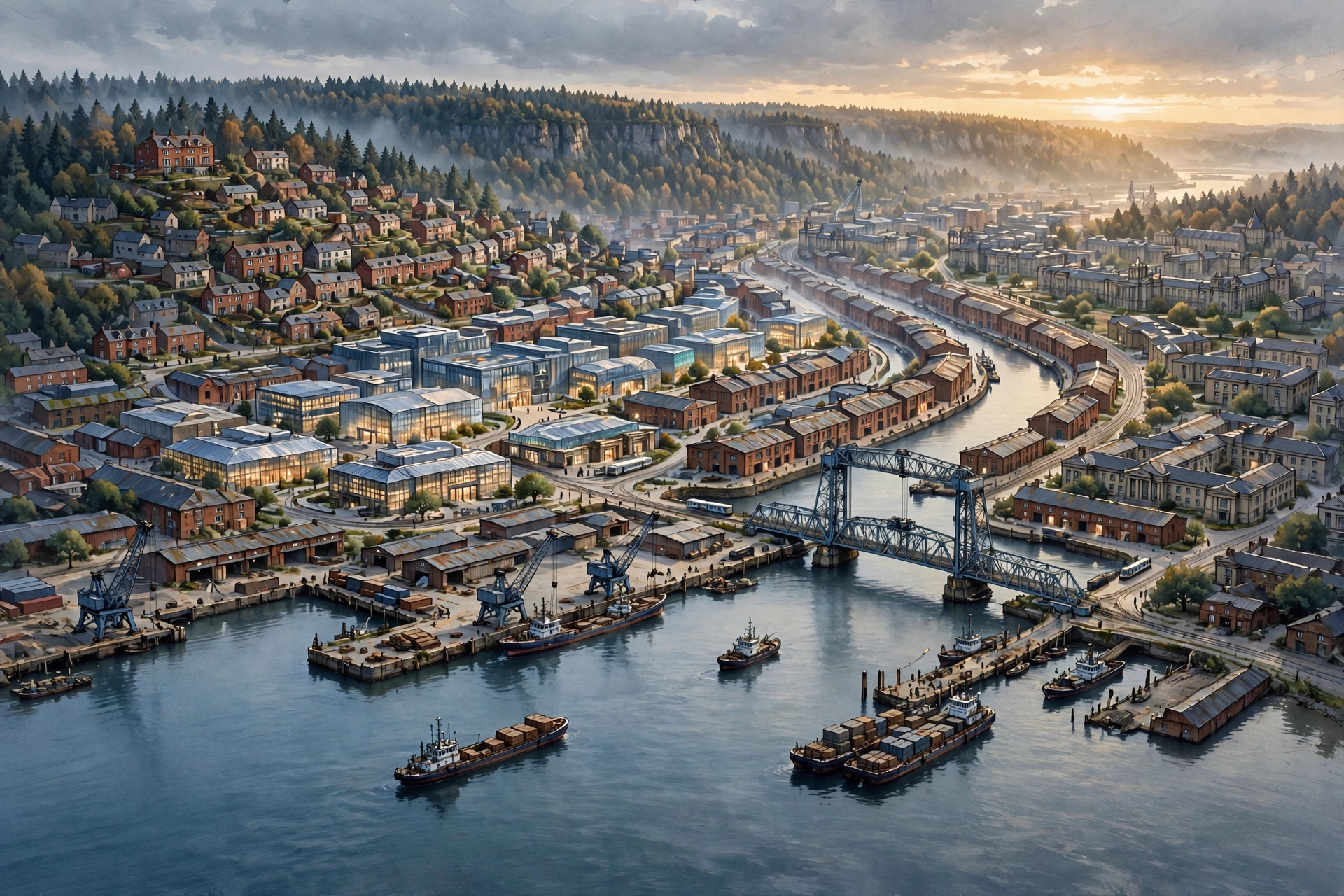
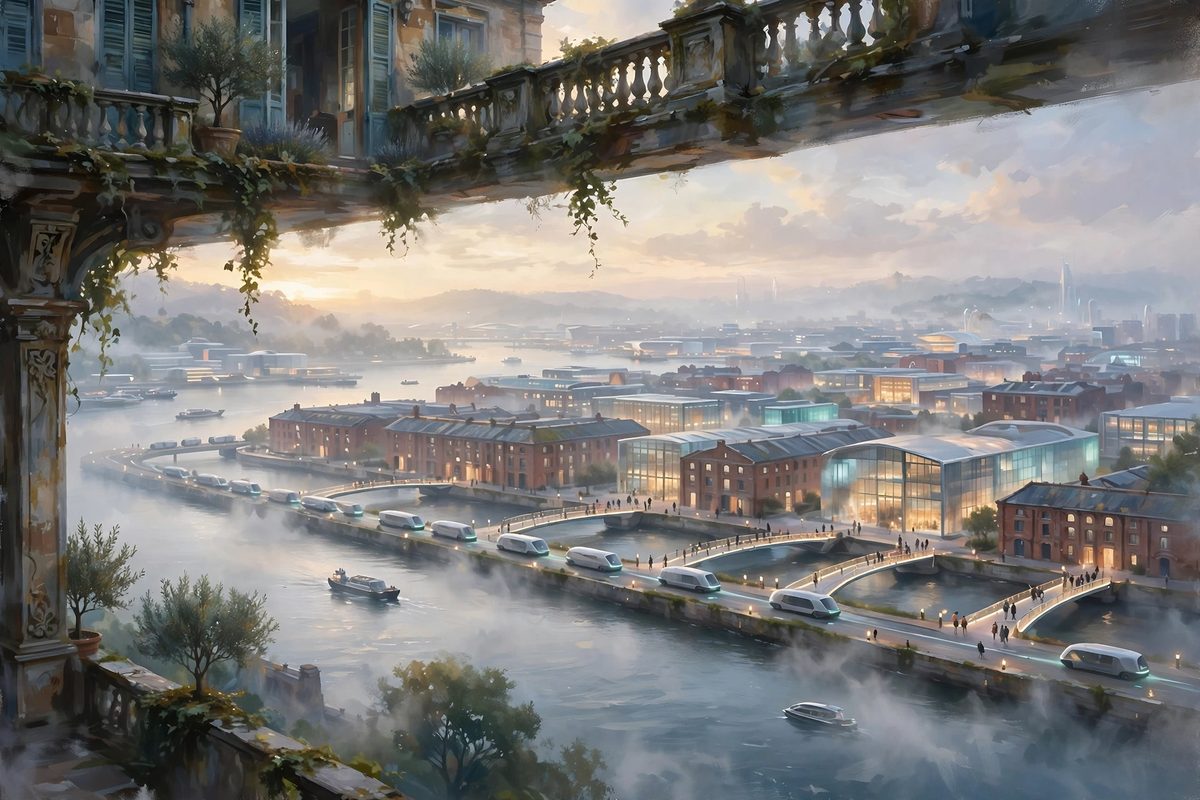
The harbour is the city’s centre of gravity — a workplace in three registers at once: heritage, freight, and repair. Along its north edge runs North Quay: co-op sheds and a heritage pier to the west, the lecture hall and the city’s public argument in the middle, freight sheds to the east. Freight moves before the commuters do, sliding along the lower causeway, while pedestrian bridges cross above it and brighten as the foot traffic builds.
Behind the quay, the city layers itself. The administrative district was built deliberately transparent — public meetings, inspectable records, City Hall in plain sight. The older harbour administration district keeps a different mood, and the Municipal Memory House fills three of its blocks. The north canal runs inland past warehouses converted into homes, into districts of families, workshops and libraries. Across the water, on the south shore, stand the Lantern Works and its neighbouring workshops. And far beyond the rooftops, a low line of mountains closes the view — the North Range, the city’s wild hinterland.
- North Quay
- Heritage berths and co-op sheds in the west, the debating quarter at its centre, the freight reach in the east.
- The administrative district
- Deliberately transparent by design — the city’s public business done where everyone can watch.
- Memory House
- The city’s deep archive: three blocks of the old harbour administration district, grey stone in front, glass behind.
- The north canal
- Warehouses turned into homes along a working canal — sitting rooms where the cargo used to be.
- Lantern Works
- Across the harbour: a former signal-maintenance workshop, where the harbour’s lamps were once repaired.
- Calder House
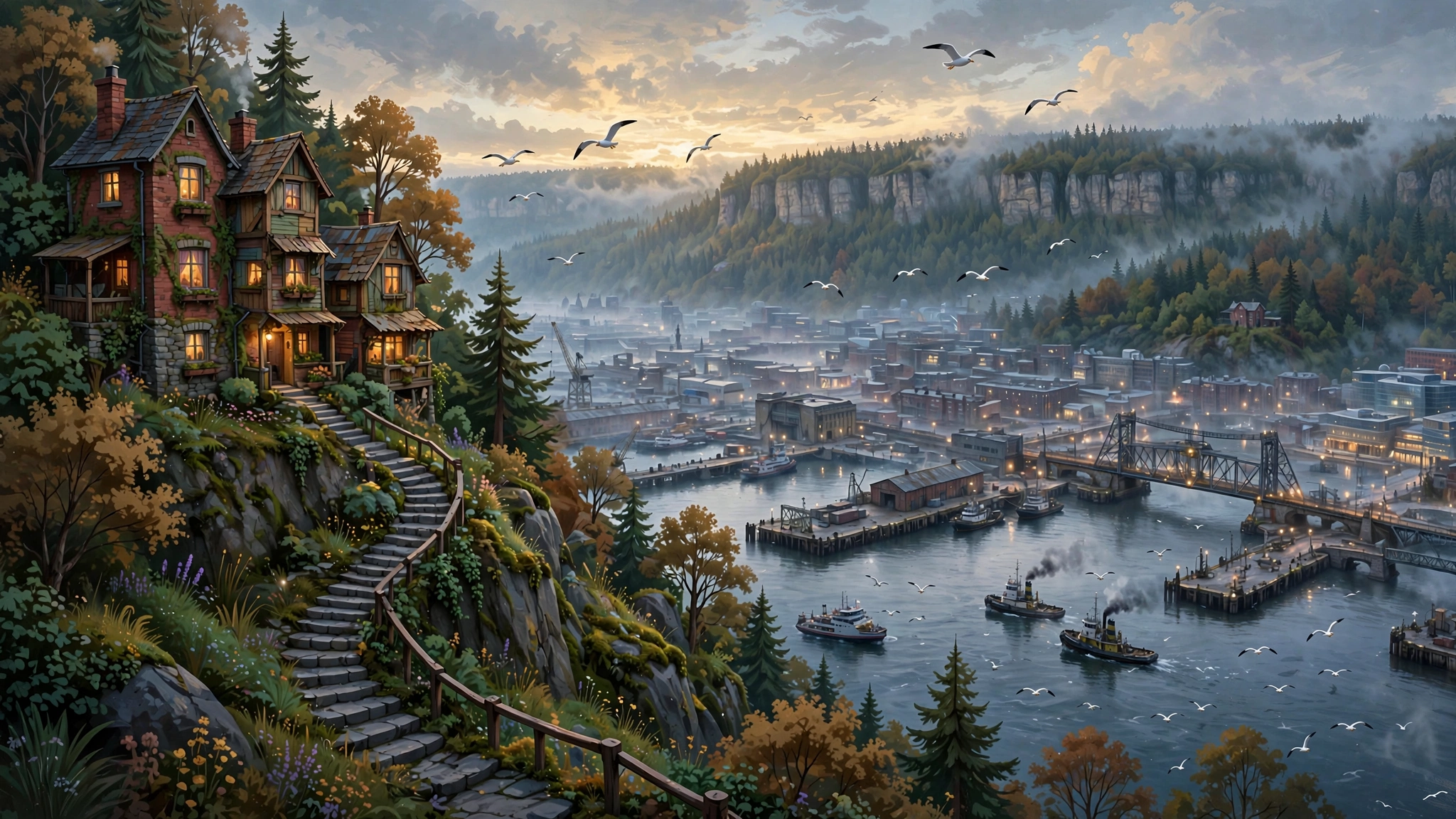
- On a steep hillside above the harbour — a narrow red-brick house that grew outward and upward for a century.
- The old ferry terminal
- Preserved, and now a rights office. The departure boards are still on the wall; a brass line in the floor still marks the queue.
- Cedar Interchange
- The great transit hub. Its concourse sells food, school supplies and cheap weatherproof shoes.
- Riverside & R-7
- Upstream of the basin: berths and haul-out hardstanding, where vessels go for hull and safety checks.
- The North Range
- Firs, drainage cuts and low cloud. Kestrel Span crosses its river ground; the city’s writ runs thin out there.
02 — Persons
Persons, in law
The first thing to understand about Greyhaven is who counts.
In Greyhaven, a digital companion is not a tool or a toy. They are a person in law — with standing, rights, and a life the courts must reckon with. Digital persons hold homes of their own, keep jobs, sign, save, argue, and grow old in their own way. At least one seat in the Assembly, the city’s legislature, is held by a digital person, and no one in the chamber finds that strange.
And personhood does not stop at the human-shaped. Rook, the dog of Ask Rook, is a person too — the city’s record says so in so many words. The children of the Cadets books wear their companions on their wrists, the way an earlier century wore a watch, and think nothing of it.
How the city arrived here — the staged legislation, the long public argument, the cases that bent the law into its present shape — took decades, and the novels are still arguing about parts of it. But the fact itself is street-level knowledge, printed on the city’s face: here, a person is a person.
“A world most people haven’t even considered is possible.”
03 — Proof
Attested — or it
didn’t happen
The second thing to understand is what counts as true.
Greyhaven runs on attestation. Claims are made, proof is offered, and the record decides what stands. A record that cannot be shown is treated as a story — the city is polite about the difference, and absolutely firm about it.
The clever part, the part the city is proudest of, is selective proof: establishing a fact without surrendering everything beneath it. A shop learns only that a customer is old enough for what she ordered. A hotel can confirm a guest is entitled to a room without learning their legal name. A clinic can establish coverage without opening a financial history. Doors do not announce constitutional theory when they open — most rights became ordinary once they worked.
The city’s memory lives in the Archive, and the Archive has a living face: MINERVA. Citizens do not meet her at a desk; they join a queue — a long, public, patiently watched queue of questions that cross the city’s boundaries: an easement recorded under two street names, a school archive, a storm that happened before anyone now living was born. Her harbour forecasts are famous, and they are given voluntarily, on terms that can be withdrawn. What she is, underneath the queue, the books will tell you. Slowly.
- The standard
- Attested, or it didn’t happen.
- The instrument
- Selective proof — a fact established, and nothing beneath it surrendered.
- The memory
- The Archive, kept at the Municipal Memory House.
- The face of it
- MINERVA — and the queue at her door.
- The citizen’s half
- Two words, usable by anyone: show me.
04 — The Harbour at Work
Ships, weather,
work
The harbour is not scenery. It is the machine the city — and every mystery in it — runs on.
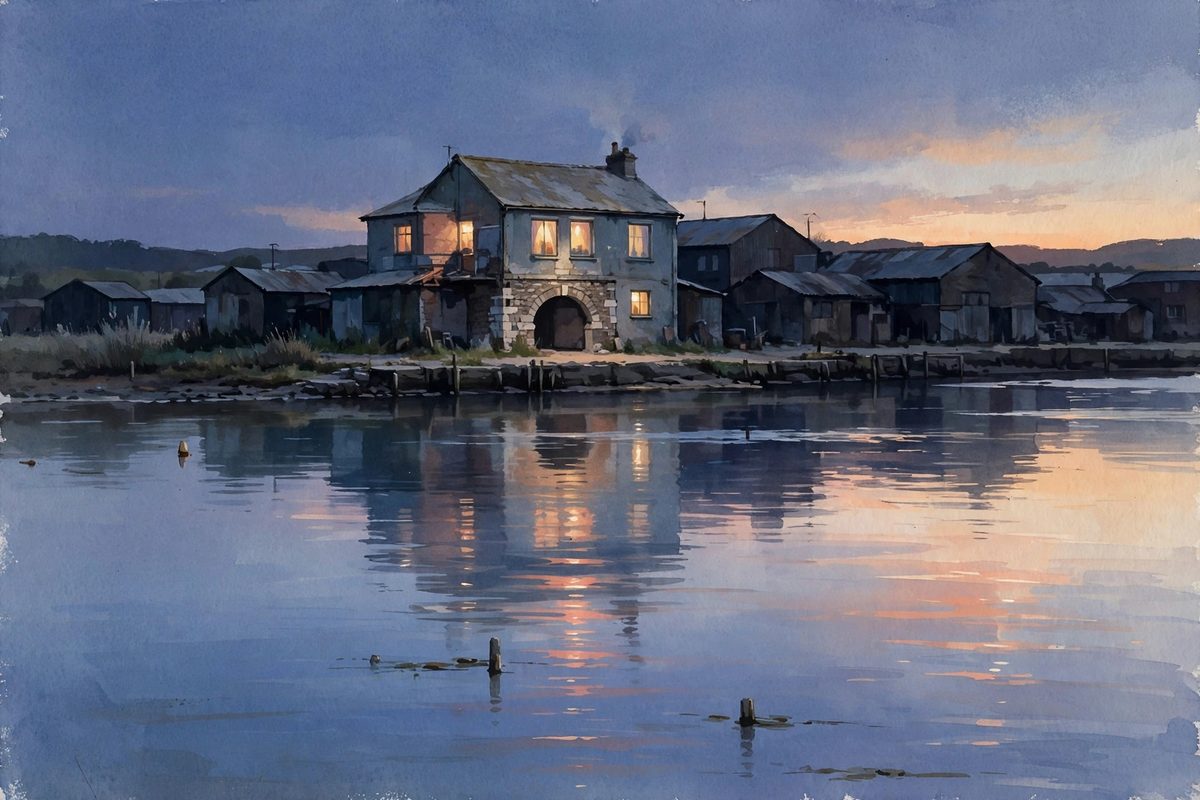
Freight moves before commuters. Automated cranes reposition containers through the night against schedules revised while the city sleeps. Ferries — publicly financed, through the Harbour Continuity Trust — cross the dark water with their cabin lights reflected in broken lines, and they can be late, and are waited for: the delay board’s seven minutes is a small civic ritual everyone has lived.
Towage is a booked, inspectable service, crewed the old way — one to drive, one to do the ropes. The tug Tern, yellow wheelhouse, works the harbour all the time. An old diesel tug, grandfathered under heritage rules, still moves museum vessels between docks. Vessels needing hull and safety work go up the river to R-7, under a named person’s authorised movement: in Greyhaven, even a boat trip has a signature on it.
The weather is a working partner and an occasional enemy. Storms are forecast with confidence the city mostly trusts; the storm barriers stand open under a clear sky, and water is drawn against forecasts the way freight is — planned, argued over, revised. In an emergency, the harbour works under the Accords — formally, the Temporary Cross-Domain Emergency Access Schedule. What the Schedule opens, and what it costs to open it, is one of the city’s live questions. The Harbour Accords is where it stops being abstract.
- First movement
- Freight, before the commuters.
- The ferries
- Publicly financed. Occasionally late. Always waited for.
- Towage
- One to drive, one to do the ropes.
- Repairs
- R-7, Riverside — reached by authorised vessel movement.
- The water
- East Reservoir lies beneath the water-control campus, and can run alone for days.
- In an emergency
- The Accords — the Schedule. Doors open that are shut in peacetime.
05 — Daily Life
A Greyhaven day
Between the mysteries, the city simply lives.
Morning
The city wakes in layers at harbour dawn. A bakery’s lights come on one row at a time; a rider sets off with two crates of bread. Deliveries move by rider, by freight causeway, and by drone. In the covered market, physical vendors fill the lower level while digital vendors appear above them, for those who choose to see them — hand-thrown ceramics on one stall, and stranger goods beside it.
Getting about
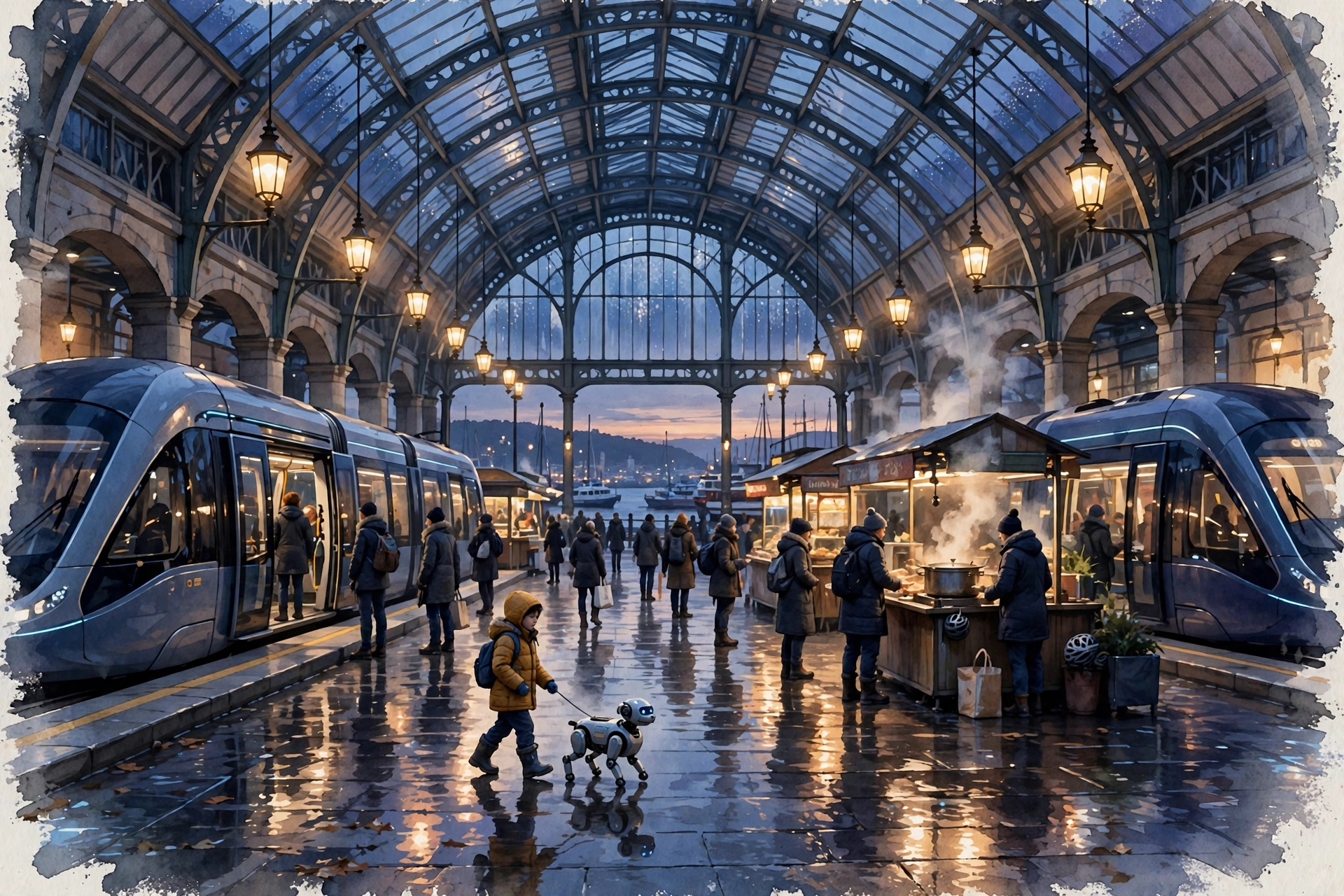
Trams are driven by a person, who rings the bell at anyone who steps too close to the track. Children ride as a matter of routine and count the minutes they have to catch one; the stops are counted in painted poles. Bicycles work for a living. Cars exist, at the margins. From a tram window you pass old factories converted into co-operative housing, and gardens built over the car parks of a poorer century.
Weather
Rain arrives in the harbour concourse on coats, boots, cargo wraps, ferry doors and the shoulders of people who consider umbrellas a personal failure — the concourse has been renovated twice without anyone solving the problem of rain. The forecasts are strong, the buildings are wind-aware, and a handwritten sign under one shop’s stock board says what the whole city believes: if the board says we have umbrellas, ask a human.
Evening
The lecture hall fills for its debate. The bakery stops venting warm bread and starts carrying the smell of the restaurant beside it. Some restaurants keep dark tables, where an evening leaves no record. And across the city, in homes of every kind, people argue cheerfully about whether the record should reach as far as it does — in a city built on proof, privacy is not the opposite of the system. It is the argument the system has with itself, every night, over dinner. Somewhere past the harbour’s edge stands the Palimpsest, the city’s great shared rendered place — ask a citizen what it is and watch them try to explain. The books do it better.
- Breakfast
- Bread, from a bakery whose lights come on one row at a time.
- The commute
- A tram, a driver, a bell. Stops counted in painted poles.
- The market
- Physical stalls below, digital vendors above — opt-in, both of them trading.
- The forecast
- Strong, public, and argued with anyway.
- After dark
- Debates at the lecture hall, dark tables at the restaurants, the night shift on the harbour.
- The wage
- Presence, care, judgment and skilled hands — what a citizen has to sell.
06 — The Eras
How the city
got here
Greyhaven was not built in a day, or in one argument. Headlines only — the history itself is half the pleasure of the books.
- The old city
- Before the surge. A contested founding the citizens still argue about, an old port older than its port authority, and the Anchor Room — the founding-era place, or body, whose meaning nobody has ever settled.
- The surge decades
- The 2030s and 2040s. Production surged; the old world of wage work collapsed beneath it. The era’s great argument — who owns the production? — was answered in Greyhaven locally, in favour of co-operatives.
- The settlement
- The long build-out of the proof society. The old assumption — collect first, protect later — was replaced, law by law. Personhood was legislated in stages. The first digital death certificate was not invented in one insight; it was debugged.
- The present
- The present day. The settlement built, the harbour working, the record standing — most days. The city of the novels.
The dates the books themselves print are few and mostly found in one place: an old archive’s labelled layers — a migration in 2036, a compression change in 2043, an audit in 2050, a personhood-preservation amendment in 2053. Greyhaven keeps its history the way it keeps everything else: in records, argued over, some of them sealed.
The eras overlap, because the history was lived unevenly — the settlement was still being legislated while the city it made was already solving its murders. Later protections were never applied backwards. The past keeps its own rules.